A tabletop exercise is a structured conversation about an incident that has not happened yet. A facilitator describes a situation one piece at a time, and the people who would handle it for real say what they would do. Nobody touches a keyboard. Nothing is restored from backup. The point is to find out, in a room where mistakes are free, whether the team knows who decides what, who needs to be told, and what information it would need to act.
That makes a tabletop different from a technical test. A penetration test asks whether an attacker can get in. A recovery test asks whether the backups work. A tabletop asks whether the people and the plan work together when the facts are incomplete and the clock is running. Most incidents that go badly go badly there: not because a tool failed, but because nobody was sure who could take a system offline, or the legal team heard about it last.
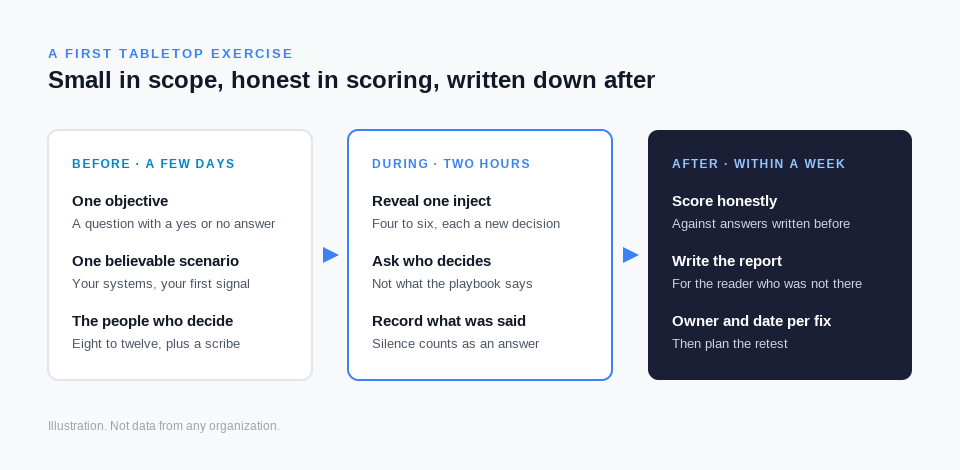
Teams put off their first exercise because it feels like a large production. It does not need to be. A useful first tabletop takes about two hours of the participants' time and a few days of preparation. What matters is that it is scoped tightly and that something is written down at the end.
Start with one objective
The most common mistake in a first exercise is trying to test everything. A scenario that covers detection, technical containment, legal notification, executive communication and recovery in ninety minutes tests none of them properly. Each topic gets ten minutes, every discussion is cut short, and the debrief produces a list of vague impressions.
Pick one thing you most want to know. Good first objectives are narrow and answerable:
- Does the team know who has the authority to isolate a production system, and can they reach that person at night?
- When a suspected incident is reported, how long does it take to reach the person who decides whether it is one?
- Does the incident response plan say who tells customers, and does the person named know that?
Write the objective as a question with a yes or no answer, plus the evidence that would settle it. If you cannot say what a good answer looks like before the exercise, you will not recognize one during it.
Choose a scenario the team will believe
The scenario should come from your own risk, not a headline. Ransomware is a common first choice because it touches every function, but a business email compromise that diverts a payment, or a cloud account taken over through a reused password, can be just as useful and easier to keep in scope.
Make it specific to how your organization works. Name the systems by their real names, or by names the team will recognize. Put the first signal where it would actually appear: a help-desk ticket, an alert in the monitoring tool, a call from a supplier. Abstract scenarios produce abstract answers. "The attacker has access to a server" invites a textbook response. "The payroll server is encrypting files and payroll runs tomorrow at six" invites a real one.
Public material can help with structure. CISA publishes free tabletop exercise packages covering many threat types, and the UK National Cyber Security Centre offers Exercise in a Box. Both are good starting points to adapt. NIST's SP 800-84 describes how test, training and exercise programs fit together, if you want the longer view.
Plan the injects as a sequence of decisions
An inject is one piece of new information, delivered at one point in the exercise. A first scenario needs four to six of them. Each should move the situation forward and force at least one decision the team has not already made.
A simple pattern works well for a first exercise:
- The first signal. Something ambiguous. The decision is whether to treat it as an incident and whom to call.
- Confirmation. The evidence firms up. The decision is what to contain and who approves it.
- Spread or escalation. The problem is larger than it looked. The decision is whether to take a business service offline.
- Outside pressure. A customer, a journalist, a regulator or the attacker makes contact. The decision is what to say, who says it, and when.
- Recovery. Systems are coming back. The decision is what has to be true before they reconnect.
For each inject, write down in advance the questions you will ask and what a strong answer would include. That written answer is what lets you score the exercise afterward instead of relying on how the room felt. We wrote more about this in Write injects that test decisions, not trivia.
Invite the people who would decide
The room should hold the people who would make the calls in a real incident, not their delegates. For most first exercises that means the incident response lead, someone from IT operations who can speak to what is possible, a legal or compliance representative, communications, and an executive with authority to approve business disruption.
Keep it small. Eight to twelve participants is enough. More than that and the quieter people stop speaking, which is exactly where the useful gaps tend to sit. If others want to watch, make them observers with a note-taking role, not participants.
Assign two roles that are not players. The facilitator runs the scenario, reveals injects, asks the questions and keeps time. The scribe writes down what the team decided, who decided it, and what they said they would need. A facilitator who also takes notes will miss things; a scribe who also plays will stop writing.
Run the room
Open by saying what the exercise is and is not. It is not a test of individuals. Nobody is graded on their personal performance. The point is to find gaps in the plan, the authority and the information, and every gap found in the room is one that will not be found during a real incident.
Then reveal the first inject and ask the first question. A few habits make the difference between a useful exercise and a pleasant discussion:
- Ask for decisions, not descriptions. "What would you do?" invites a tour of the playbook. "Who decides, and what do they decide?" gets to the point.
- Ask how they would know. When someone says "we would check the logs," ask which logs, who has access, and how long it would take.
- Let silence work. When nobody answers, that is information. Write it down before rescuing the room.
- Hold the clock. If one discussion runs long, note the open question and move on. An exercise that covers three injects well and skips two is better than five covered badly.
- Separate the plan from the practice. When the room says "the plan says legal is notified," ask who in legal, and whether that person knows it.
Score it honestly
Scoring sounds formal for a first exercise, but it is what turns impressions into findings. For each question, compare what the team said with the strong answer you wrote beforehand, and grade it on a simple scale. MetisForge uses four bands for each answer: Excellent, Good, Adequate and Poor, always assigned by a person.
The scale matters less than the habit. A score with a one-line reason ("named the decision but not who makes it") is evidence you can compare next time. "Went well overall" is not.
Keep what the exercise found
The exercise is not finished when the room empties. Within a week, write a short report: the objective, the scenario, what the team did at each inject, what was missing, and what will change. Each change needs an owner and a date, or it is a wish. What belongs in that report is covered in What a useful after-action report contains, and how to make the changes actually happen in From exercise finding to closed gap.
Then schedule the next one. A single tabletop tells you where you are. A second one, run against the same objective after the fixes, tells you whether anything changed.
Where MetisForge fits
MetisForge is built for the whole cycle: a scenario written for your industry and threat, injects with questions and model answers, a facilitator console that reveals one question at a time, scoring by a person, and a report with a corrective action plan. To see what a finished report looks like, open the sample after-action report. To watch a recorded exercise in the facilitator's console, try the interactive demo.