Most tabletop exercises are only as good as their injects. An inject is one piece of new information delivered at a set point in the scenario: an alert, a phone call, a message from the attacker, a note from finance. The team reads it, discusses it, and answers the questions that come with it. Whatever those questions ask is what the exercise measures.
That is where many exercises go wrong. The scenario is realistic, the room is full of the right people, and the questions ask things like "What is lateral movement?" or "Which MITRE ATT&CK tactic does this represent?" The team answers correctly, everyone feels good, and the exercise has tested whether the security team reads the same blogs as the facilitator. It has not tested whether anyone knows who can take the payment system offline at two in the morning.
A good inject puts the team in front of a choice it would really face, with the information it would really have, and asks what it does next.
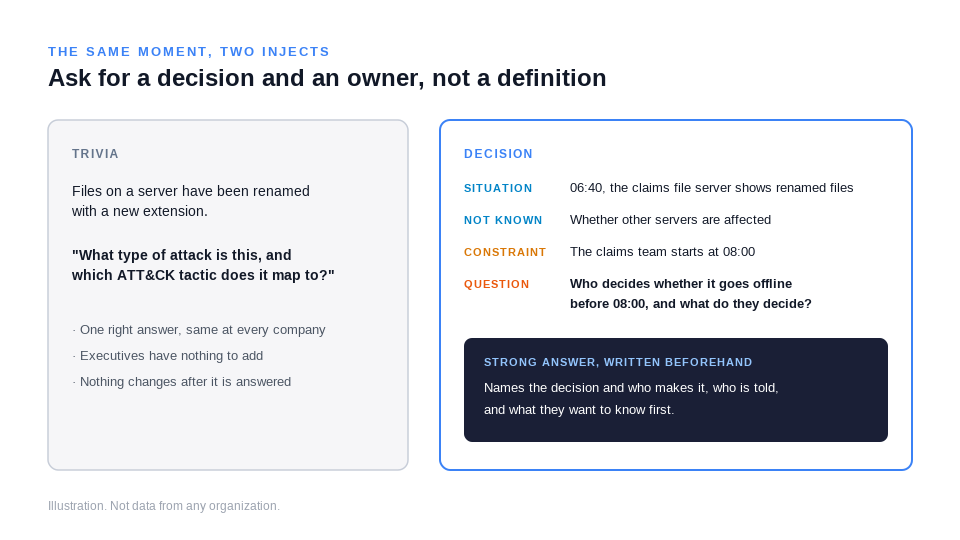
Trivia questions have answers you can look up
A trivia question is one where the right answer exists outside the organization. What does this log line mean? What kind of malware encrypts files? What does the incident response plan say in section four? These have a place in training, but in an exercise they waste the scarce thing: time with the people who make decisions.
There are three tells that a question is trivia:
- It has one right answer that does not depend on your organization. If the answer would be the same at every company, it is not testing yours.
- The most senior person in the room cannot contribute. If the chief financial officer has nothing to add, the question is not about a decision the business makes.
- Nothing changes depending on the answer. A decision question shapes what happens next. A trivia question is answered and forgotten.
A decision inject has five parts
When we write injects, we check each one against the same five parts. An inject missing one of them usually produces a vague discussion.
- A situation in the team's own words. Name the system, the person who reported it, and the time. "At 06:40 the overnight operator reports that the file server used by the claims team is showing renamed files with an unfamiliar extension" is concrete enough to argue about.
- What the team knows, and what it does not. Real incidents arrive with gaps. Say plainly what has not been confirmed. The gap is often where the decision lives: do you act before you know?
- A constraint. Something that makes the obvious answer costly. The claims team starts work at eight. The backup administrator is on a flight. The server is shared with a system finance needs for a month-end close. Without a constraint, every team chooses the textbook answer.
- A question that asks for a decision and an owner. Not "what would you do?" but "Who decides whether the file server goes offline before eight, and what do they decide?" The owner is part of the answer.
- A written strong answer. Before the exercise, write what a good response includes. Not a script, but the elements you would expect: the decision, who makes it, who is told, what information they would want first, and what they would avoid. This is what makes the inject scoreable.
Build pressure across the sequence
Injects work as a sequence, not as separate questions. Each one should change the situation enough that the previous decision has consequences. A useful arc for a scenario of five or six injects:
- The first inject is ambiguous, and the decision is whether to treat it as an incident.
- The second confirms something, and the decision is what to contain.
- The third widens the problem past what the team planned for.
- The fourth brings in an outside party: a customer, a regulator, a journalist or the attacker.
- The last one or two test recovery and what has to be true before systems reconnect.
Pressure comes from two directions at once: the technical situation getting worse, and the business cost of each option rising. An inject where only one of those moves is easier than one where both do. The best questions in a late inject are ones where every option costs something and the team has to say which cost it accepts.
Use decision points when the choice should matter
Some exercises go further and let the team's answer change what comes next. At a decision point, the team picks one of two or three options, and the following injects follow from that choice. If it chose to keep a system running while investigating, the next inject shows what that cost. If it took the system down, the next one shows who complained.
Decision points make an exercise feel less like a quiz, but they bring one discipline that is easy to miss: the team must never see the option it did not pick. An inject that says "if you chose path A" or lists the alternatives tells the team that a right answer exists and invites it to guess. Write each branch as though it were the only story.
Keep the answer material away from the players
Model answers, scoring guidance and facilitator notes belong to the facilitator. If participants can see them, even by accident on a shared screen, the exercise stops measuring the team and starts measuring its reading speed. Keep the facilitator's material in a separate document or view, and check the participant handout for anything that hints at the answer, including headings, file names and the order of options.
Test the inject before the room does
Read every inject aloud before the exercise, as the facilitator will. A few checks catch most problems:
- Could the team answer this without discussing it? If so, the question is too easy or too narrow.
- Does any detail in the situation give the answer away?
- Is there more than one reasonable answer? There should be, or there is no decision.
- Would the most senior participant have something to say?
- Can you score the answer against what you wrote, in a sentence?
The last check matters most. An inject you cannot score produces a discussion you cannot compare. Six months later, when the same scenario is run again, the written strong answer is what shows whether the team improved.
Where MetisForge fits
MetisForge writes scenarios as injects with questions, model answers and success criteria for each objective, and gives each inject a read-aloud script for the facilitator. Before a scenario is saved, an AI check looks for answers given away in the inject text, and branching scenarios are checked so that the team never sees the option it did not take. Model answers stay with the facilitator; participants see only the questions as they are revealed.
If you are planning a first exercise, start with How to run your first cybersecurity tabletop exercise. To see injects with scored answers in a finished report, open the sample after-action report.