A tabletop exercise lasts two hours. Its after-action report is what remains a year later, when an auditor asks what the last exercise found, when a new security lead wants to know what was tested, or when a real incident follows the same path and someone asks whether anyone saw it coming.
Most after-action reports are not written for that reader. They are written the week after the exercise, by someone who was in the room, for others who were in the room. They say the exercise went well, the team engaged, and communication could improve. A year later, nobody can tell from them what was tested, how the team did, or what changed.
A useful report is written for the person who was not there.
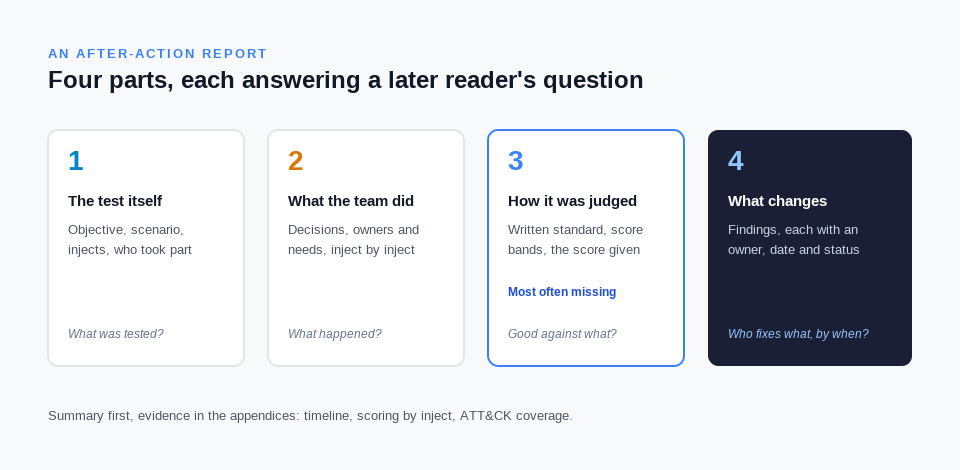
The four parts of one record
Every useful after-action report answers four questions. The headings vary; the questions do not.
- What was tested? The objective, the scenario, the injects in order, and who took part by role. Without this, a reader cannot judge whether a finding is about the team or about an unusual scenario.
- What did the team do? At each inject, what the team decided, who decided it, and what it said it would need. This is the evidence. It should be specific enough that someone could disagree with the score.
- How was it judged? The standard each answer was compared against, and the score it received. A report that says "Good" without saying good against what is an opinion.
- What changes because of it? Each finding, with an owner, a date and a way to know it is done.
When a report misses one of these, it is usually the third. Teams record what happened and what they plan to fix, but not the standard they measured against. That makes the next exercise impossible to compare with this one.
Start with a summary someone will read
The first page is the only page many readers will see. It should say, in plain words, what the exercise tested, how the team did overall, the two or three findings that matter most, and what is being done about them.
An overall score helps here, if it is honest. A readiness percentage measured against a stated target (for example, 80 percent) tells an executive more in one line than three paragraphs of narrative. The target should be stated in the report, not assumed. So should the bands: in the MetisForge report, 90 percent and above is Strong, 70 to 89 is Good and meets the passing threshold, 50 to 69 is Adequate, and below 50 needs improvement. Whatever scale you use, print it where the reader can see it.
Score against something written beforehand
The fairest score compares what the team said with a strong answer written before the exercise. That written answer does not need to be long. A few elements per question are enough: the decision expected, who should make it, who should be told, and what the team should want to know first.
Scoring this way does three things. It keeps the score from depending on how confident the room sounded. It lets a second reviewer check the scoring. And it lets next year's exercise use the same standard, so a change in score means a change in the team.
Scores should be given by a person who understands the organization. Tools can help, for example by suggesting how an answer compares with the model answer, but the judgment of whether "we would call legal" is good enough belongs to someone who knows whether legal answers the phone at night. In MetisForge, each answer gets one of four bands (Excellent, Good, Adequate or Poor), and the optional answer indicator shows a suggestion but never chooses the score.
One distinction matters in the record: an answer that was not given is not the same as a poor answer. If a question was skipped for time, say so. If the team was asked and had nothing to say, say that. They mean different things.
Write findings someone can act on
A finding is a gap between what the team did and what it needed to do, written so that someone can close it. Compare:
- "Communication could be improved during escalation."
- "Authority to isolate the fund accounting servers was not delegated before the exercise. During inject 4, the team spent the discussion working out who could approve it, and could not reach that person out of hours."
The first is true of every exercise ever run. The second names the gap, the system, the evidence from the exercise, and why it matters. It also suggests its own fix: delegate the authority, document it, and test that the delegate can be reached.
Good findings share a shape:
- What was missing, stated as a fact, not a feeling.
- Where it showed, with the inject and the evidence from the record.
- Why it matters, in business terms: time lost, a decision delayed, a notification missed.
- What would close it, specific enough to assign.
Do not hide strengths. A report that only lists gaps is read as a failure, and teams learn to resist exercises that produce one. Name what worked, with the same precision as what did not. It also tells the next facilitator what not to waste time testing again.
Turn findings into a corrective action plan
Each finding should map to at least one corrective action, and each action needs four things: an owner, a due date, a priority and a status. An action without an owner is not assigned. An action without a date is not scheduled. A report whose actions are never revisited is a record of what was known and not done, which is a worse position than not having run the exercise.
The plan is the part of the report that changes over time. It should be easy to update without rewriting the report around it. How to keep those actions moving, and when to call one closed, is the subject of From exercise finding to closed gap.
Keep the evidence in appendices
Behind the summary and findings, keep the record that supports them: a timeline of the exercise (when each inject was revealed and when the team responded), the full scoring by inject and question, and, if your scenarios map to MITRE ATT&CK, the techniques the exercise covered. Most readers will never open the appendices. The ones who do are the ones whose trust matters: auditors, regulators, and next year's facilitator.
Many frameworks ask organizations to test their incident response and keep a record of the results. NIST's guidance on test, training and exercise programs is one example; ISO/IEC 27001, PCI DSS and DORA carry similar expectations in their own terms. A report with the four parts above is the kind of evidence those expectations describe. It aligns with them; it does not certify anything. Your auditors decide what satisfies them.
Control the document
An after-action report often contains sensitive detail: which systems are weak, who could not be reached, how an attacker might succeed. Treat it as a controlled document. Give it a version, an author, a reviewer and a release date. Mark draft versions as drafts. Decide who can read the released version before it is released, not after.
Where MetisForge fits
MetisForge produces this report from the exercise itself: an executive summary with a readiness score against an 80 percent target, performance by inject, findings, strengths, lessons learned, a corrective action plan with owners and dates, and appendices with an evidence timeline and MITRE ATT&CK coverage. Reports move from draft to review, approval and release, and export to HTML or PDF.
The quickest way to judge whether it is useful is to read one. The sample after-action report is a complete report from a fictional ransomware exercise. For how exercise records line up with common frameworks, see framework alignment.