Ask a security team what its last tabletop exercise found, and most can tell you. Ask what has changed since, and the answer is usually less clear. The findings were real, the report was written, and the actions were agreed in the debrief. Then the quarter got busy, the people who owned the actions moved on to other work, and the next exercise found the same gaps.
This is the most common way exercise programs fail. Not in the room, but in the weeks after it. An exercise that finds a gap and does not close it has spent the team's time producing a record of known weaknesses, which is a worse position to be in than not knowing.
The fix is not more discipline in general. It is a specific path that every finding follows, with a clear rule for when it is finished.
A finding is not an action
The first step is separating two things debriefs tend to blur. A finding is what the exercise showed: "authority to isolate the payroll servers was not delegated, and the team could not reach the person who holds it out of hours." An action is what will be done about it: "delegate isolation authority to the on-call infrastructure lead, document it in the response plan, and add the delegate's number to the out-of-band contact list."
One finding can need several actions. Some findings need an action outside the security team entirely: a change to an approval policy, a contract clause with a supplier, a budget request. Writing them separately lets you see when every action is done but the finding is still open, which happens more often than it should.
Every action needs four things
An action that will actually be completed has:
- An owner. One person, by name, not a team. Teams do not complete actions; people do.
- A due date. Realistic, agreed with the owner, and close enough that someone will notice when it passes.
- A priority. Not every finding is urgent. A gap that would have stopped the response in its first hour comes before one that would have slowed the press statement.
- A status. Open, in progress, done, or blocked, updated by the owner, visible to whoever runs the exercise program.
This is the shape of a corrective action plan. It is not complicated, and its value comes almost entirely from being looked at. A plan reviewed every month, with overdue actions raised to someone who can unblock them, gets done. A plan attached to a report and filed does not.
Decide what "fixed" means before you fix it
The hardest question in tracking findings is when to call one closed. The easy answer is when the owner says the action is done. The document was updated. The authority was delegated. The phone number was added.
The trouble is that a completed action is not the same as a closed gap. The response plan can name a delegate who does not know they are one. The contact list can be updated and stored on the file server that ransomware would encrypt first. The training can be delivered and not retained. Each of these is "done" on paper and would fail in the same way during a real incident.
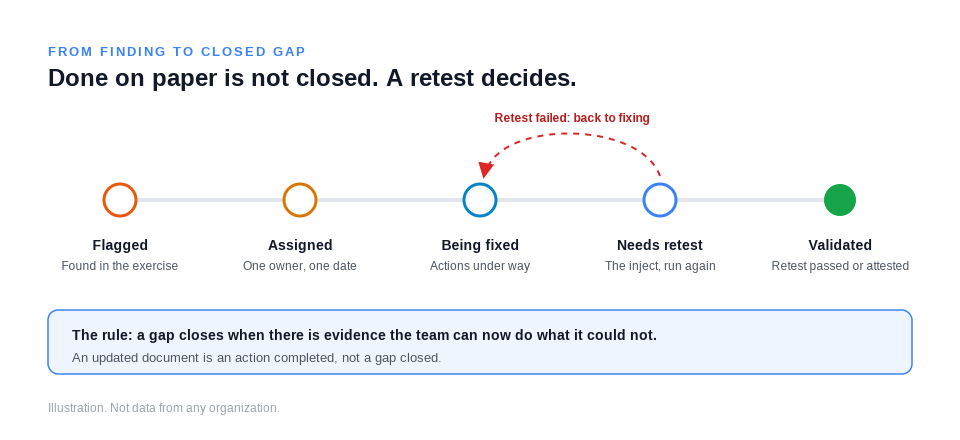
A stricter rule works better: a gap is closed when there is evidence the team can now do the thing it could not do before. That evidence usually comes from one of two places:
- A retest. Run the part of the scenario that exposed the gap again, with the people who would be involved, and see whether the outcome changes. It does not need a full exercise. Fifteen minutes with the right inject is often enough.
- An attestation. For gaps a retest cannot easily reach, a named person with the authority to judge confirms, in writing, that the fix is in place and works. This is weaker than a retest, and should say who attested and on what basis.
When a retest fails, the gap goes back to open, with what the retest showed. That is not a failure of the program. It is the program working: it found that the fix did not fix it, before an incident did.
Track the gap through stages, not just open and closed
Binary tracking hides the useful information. A gap that is "open" might be untouched, or fixed and waiting for a retest, or retested and failed twice. Those need different responses.
A small set of stages makes the state visible at a glance: flagged, assigned, being fixed, needs retest, validated. Leadership can see how many gaps are waiting on a retest, which is often the bottleneck, and the exercise lead can build the next exercise around them.
Close the loop with the next exercise
The most efficient retest is the next exercise. When planning it, start from the open findings of the last one. If the team could not reach the person with isolation authority, the next scenario should test that again, at night, with the delegate in the room. If notification ownership was unclear, the next scenario should put the notification decision in front of whoever owns it now.
This turns an exercise program from a series of separate events into a single line of improvement. Each exercise tests something new and checks something old. Over a year, the reports show not only what was found, but what was fixed and proven fixed, which is the question boards and auditors actually ask.
Findings come from more than exercises
Tabletop exercises are one source of gaps. Threat hunts are another: a hunt that cannot answer its question because the data does not exist has found a visibility gap, and it deserves the same treatment, an owner, a date and a way to know it is closed. We wrote about that in Threat hunting starts with a question, not a query. Real incidents produce lessons too, and those are the most expensive findings of all, because they were learned the hard way.
When all three feed the same tracking, patterns show up that no single source would reveal. The same weak point appears in an exercise, a hunt and a near miss, and it moves up the list.
Where MetisGrid fits
In MetisForge, every after-action report carries a corrective action plan where each action has an owner, a due date, a priority and a status. Gaps found in an exercise go to training, then to a practical retest, and each one is tracked by stage from flagged to validated. Only a passed practical retest or a human attestation closes a gap. In MetisHunter, a hunt cannot close without an outcome, such as a detection, a control change or a data gap, each with an owner and a status, and a closed hunt can become the next tabletop.
For what the report around those actions should contain, see What a useful after-action report contains. For how exercise records line up with common frameworks, as alignment and not certification, see framework alignment.