When ransomware hits, the security team's work is technical: find the spread, stop it, preserve evidence, start recovery. But within hours, the questions stop being technical. Can we shut down the system the business runs on? Who tells customers? Do we talk to the attacker? Those questions belong to executives, and they arrive whether or not the executives have thought about them in advance.
In tabletop exercises, this is where teams struggle most. Not because executives make poor decisions, but because they meet the decisions for the first time during the incident, without knowing who has the authority, what information they should demand, or which clocks have already started.
This post walks through six decisions that tend to reach the executive level in the first day of a ransomware incident. None of them has a universal right answer. Each of them has a wrong way to arrive at an answer: late, by the wrong person, or without the facts that should drive it.
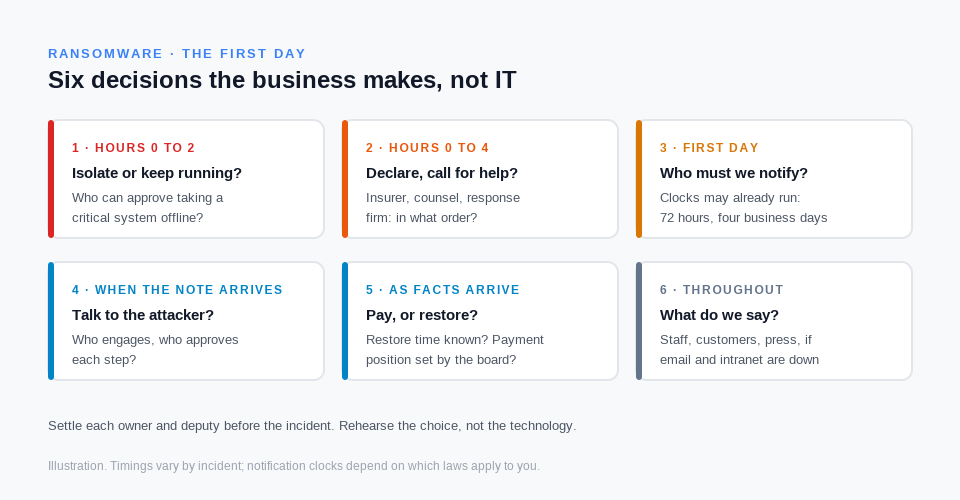
1. Do we take the business offline?
The first executive decision is usually the hardest: whether to isolate systems the business depends on, knowing it stops revenue, operations or service to customers. The security team can recommend it. Someone with business authority has to approve it, and fast, because every hour of delay can let the encryption or the attacker's access spread.
What makes it hard in practice is not the choice but the authority. In exercises, a common finding is that nobody in the room is sure who can approve isolating a production system, and the person who can is not reachable out of hours. The team spends the inject working out the chain of approval instead of making the decision.
What to settle in advance: who can authorize isolating each critical system, who deputizes when that person is not reachable, and what the security team can isolate on its own authority without waiting.
2. Do we invoke the plan and bring in outside help?
Declaring a major incident sets things in motion: the incident response plan, the retainer with an outside response firm, the cyber insurer's notification requirements, outside counsel. Each of these takes time to engage, and some insurance policies set conditions on which firms you use and when you tell the insurer.
Executives often hesitate here because declaring an incident feels like admitting a failure, or because the evidence is still incomplete. The cost of waiting is that outside help arrives later, and the conditions of the insurance policy may not be met.
What to settle in advance: what evidence is enough to declare, who declares, and the order of calls: insurer, counsel, response firm. Keep the numbers somewhere that does not depend on the systems that may be encrypted.
3. Who do we have to notify, and when?
Ransomware incidents increasingly involve data theft as well as encryption. Once data may have left, notification obligations can start, and several of them run on short clocks. Two examples:
- Under the EU's General Data Protection Regulation, a controller must notify the supervisory authority of a personal data breach without undue delay and, where feasible, within 72 hours of becoming aware of it (Article 33).
- US public companies must disclose a cybersecurity incident they determine to be material on Form 8-K, generally within four business days of that determination, under the rules the SEC adopted in July 2023.
Sector regulators, contracts with customers, and other jurisdictions add their own. The executive decision is not whether the law applies; counsel answers that. It is who owns the determination, how quickly the facts reach them, and who drafts and approves the notices.
What to settle in advance: a list of the obligations that apply to you, with their clocks, owned by counsel; who decides materiality, if that applies; and who signs each notice.
4. Do we talk to the attacker?
The ransom note usually invites contact. Whether to respond, who responds, and through what channel are decisions with consequences: contact can buy information about what was taken, and it can also commit the organization to a negotiation it has not decided to have.
This is one of the decisions most worth rehearsing, because the instinct in the moment varies widely between people. Some want to engage immediately to learn more; others refuse on principle. Neither instinct is a plan.
What to settle in advance: whether you would engage at all, who would do it (typically a specialist working with counsel, not an employee improvising), and who must approve each step.
5. Pay, or restore?
The payment question sits on top of facts the executives do not yet have: whether backups are intact and how long a restore would take, what data was taken, and what the attacker is likely to do with it. It also carries legal risk. The US Treasury's Office of Foreign Assets Control has published an advisory on the sanctions risks of facilitating ransomware payments, updated in September 2021. A payment to a sanctioned party can be a violation, whatever the circumstances.
Most organizations discover during their first exercise that they cannot answer the restore question with confidence. They know backups exist; they do not know how long a full restore of a critical system takes, or whether the backups were reachable from the compromised network. That gap is worth more to close than any policy on payment.
What to settle in advance: your organization's position on payment, written and approved by the board or its delegate; who would decide in the moment; and a tested estimate of restore time for each critical system.
6. What do we tell staff and customers?
Staff will know something is wrong before they are told. Customers may hear from the attacker, the press or social media first. Silence gets filled with rumor; saying too much too early can create legal exposure or contradict what you learn later.
The executive decision is the line: what you can say with confidence now, who says it, through which channels, and how often you will update. Holding statements written in advance save hours and avoid improvising under pressure.
What to settle in advance: who speaks for the organization, draft holding statements for staff, customers and press, and the channels you will use if email and the intranet are down.
Rehearse the decisions, not the technology
The joint #StopRansomware Guide is a good public reference for the technical side of preparation and response. The executive side is harder to learn from a document, because the difficulty is not knowing the options. It is choosing between them with incomplete facts, a business under pressure, and other people waiting on the decision.
A ransomware tabletop for executives works best when every inject ends with a decision and an owner, not a technical question. Put the business cost in the inject: the payment run due in the morning, the customer whose deliveries stop, the board meeting in two days. Then ask who decides, and what they need to know first. We wrote more on building those injects in Write injects that test decisions, not trivia.
The findings from such an exercise are usually short and very concrete: an authority that was never delegated, a phone number stored only on the encrypted file server, a notification clock nobody owned. Each of them is cheap to fix before an incident and expensive to discover during one.
Where MetisGrid fits
MetisForge builds ransomware and other scenarios for your industry, with decision points where the team's choice sets the path, and scores the answers against model answers written in advance. The sample after-action report comes from a fictional ransomware exercise and shows findings of exactly this kind, including isolation authority that had not been delegated and an unclear escalation and notification sequence. When an incident is real, MetisCase starts from a ransomware first 24 hours task template, with the incident timeline inside the case.