The OODA loop is one of the most quoted ideas in security and one of the least practiced. Observe, orient, decide, act: the four steps come from John Boyd, a US Air Force officer who studied why some pilots consistently won air combat against better aircraft. His answer was not that they reacted faster. It was that they made sense of a changing situation faster than their opponent, and acted in ways that left the opponent's picture out of date.
Incident response fits the model closely. An attacker is inside the network, moving and adapting. The defenders watch signals, form a picture of what is happening, choose a response, and carry it out, while the attacker does the same. The side that cycles through that loop with better judgment, and at a pace the other cannot match, tends to win.
The trouble is that most teams treat the loop as a slogan. They say "speed matters" and measure time to respond. Time matters, but the loop says something more specific: where time is lost, and why being fast at the wrong step makes things worse.
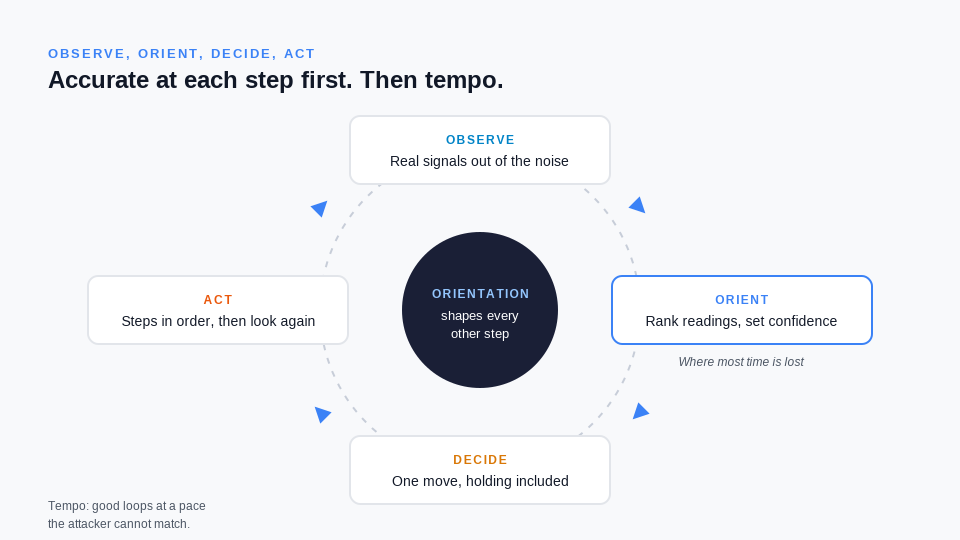
Observe: the signal is in the noise
Observation in a security operations center is not a lack of data. It is too much of it. Alerts, logs, emails from users, help-desk tickets: the evidence of an intrusion is usually present early, mixed in with ordinary activity that looks similar.
Good observation is selective. It means noticing the sign-in from an unfamiliar device that followed a password reset, and not spending ten minutes on the antivirus alert that fires every Tuesday. It also means knowing when you do not have enough to go on and need to collect more, while accepting that collecting more costs time the attacker is using.
The common failure here is not missing the signal. It is treating every signal as equally important, which is the same as having no observation at all.
Orient: where most of the time goes
Boyd considered orientation the most important step of the loop, and in incident response it is where teams lose the most ground. Orientation is making sense of what you observed: is this a phishing compromise or a misconfigured service account? An attacker preparing for ransomware, or an insider copying files before leaving?
Orientation is shaped by everything the responder brings to it: experience, training, what the last incident looked like, what the playbook says. That is its strength and its risk. A team that has seen many phishing incidents orients quickly toward phishing, which is right most of the time and badly wrong when it is not.
Three habits improve orientation:
- Hold more than one reading. Rank the two or three explanations that fit the evidence instead of committing to the first one.
- Name your confidence. "Probably credential theft, maybe sixty percent" invites the next observation that would confirm or rule it out. "It's credential theft" ends the search.
- Map it to what the attacker would do next. Placing the activity in a framework such as MITRE ATT&CK, at the tactic level, tells you what to watch for next if the reading is right.
Decide: one move, chosen on purpose
A decision in incident response is a choice of one move from several: block the account, isolate the host, watch and gather more evidence, deceive the attacker with a decoy. Each move has a cost. Blocking tells the attacker they have been seen. Watching gives them more time. The decision is about which cost to accept.
One option deserves special attention: deliberately holding and watching. It is a legitimate move, and sometimes the best one, when acting early would tip off an attacker whose full access you do not yet understand. But it has to be a choice, made with a reason and a time limit, not the absence of a decision.
Teams skip this step more often than they think. A responder who has a playbook can go straight from orientation to action: "it's phishing, run the phishing playbook." That is fast, and it is right when the orientation is right. When the orientation is wrong, the team acts quickly on the wrong problem.
Act: in order, and watch what happens
Acting is carrying out the decision, which in practice means several steps in a sequence: preserve evidence, disable the account, revoke sessions, isolate the host, notify the owner. The order matters. Revoking sessions before preserving evidence can destroy what you need to understand the scope. Isolating the host before disabling the account leaves the attacker free to sign in elsewhere.
And acting is not the end of the loop. Every action changes the situation, and the attacker responds. The next observation starts immediately: did the move land, did it only help a little, or did the attacker see it coming and adapt?
Tempo is not speed
This is the part of Boyd's idea most often lost in translation. Tempo is not doing each step as fast as possible. It is completing good loops at a pace that keeps your picture of the situation current while the attacker's picture of your response falls behind.
A team that observes everything and orients slowly is careful and late. A team that acts instantly on a shallow orientation is fast and often wrong, and each wrong action costs a loop to recover. A team with tempo is accurate at each step and does not linger at any of them. It is why accuracy should come first in practice: there is little value in being fast at a loop you are getting wrong. Once accuracy is reliable, the gains come from pace.
Practice each step on its own
The usual way to train incident response is to run whole scenarios and judge the outcome. That tells you whether the team succeeded, but not which step of the loop failed. A missed containment might be a failure of observation (the signal was never noticed), orientation (it was noticed and misread), decision (correctly read, poor move) or action (right move, wrong order). Each needs different practice.
Scoring each step separately makes the weak one visible. A responder who observes well and orients poorly needs different training from one who orients well and freezes at the decision. Over repeated drills, the scores show which step is improving and which is not.
Tabletop exercises and loop drills complement each other. A tabletop tests how a team and its leaders decide together over hours; we wrote about those executive decisions in The ransomware decisions executives face on day one. A loop drill tests how one responder works through minutes of a live intrusion, one step at a time.
Where MetisLoops fits
MetisLoops is OODA loop training for incident responders. One person plays a fictional incident against an attacker on a clock, one or two loops per drill. Observe means marking the real signals in a feed of alerts, logs, mail and tickets, where noise counts against you. Orient means ranking the readings, choosing an ATT&CK tactic and setting a confidence. Decide means picking one move, with exactly one option to hold and watch. Act means putting the steps in order. Each step is scored on its own, the debrief names the weakest step, and tempo is reported separately as feedback: when every step scores well, tempo is the next gain.
You can try a complete drill without signing up in the MetisLoops demo.